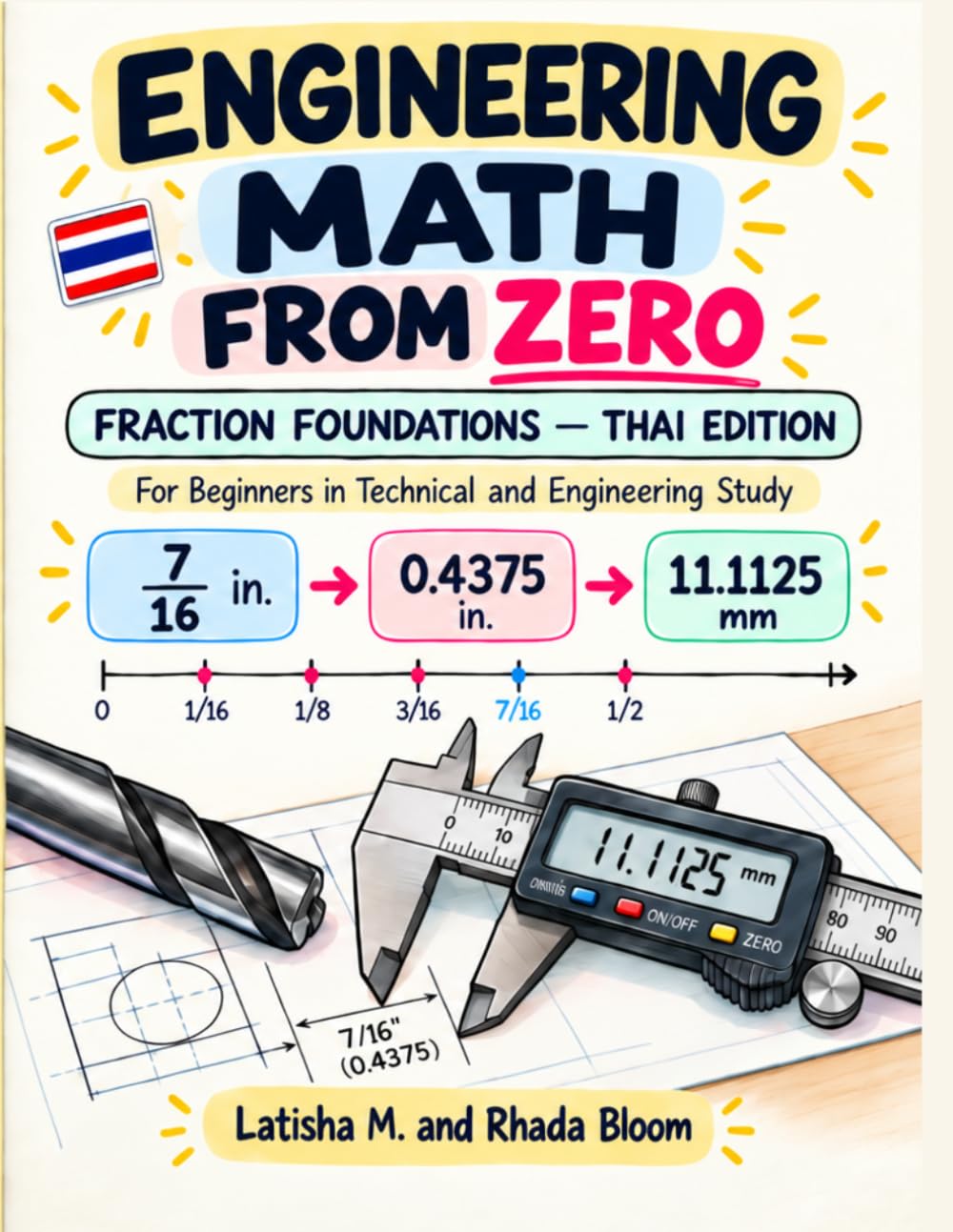
This book is for
Beginners who are not yet confident with fractions, mixed numbers, or decimals;
Adults returning to mathematics after a long break;
Vocational, technical, and engineering students who want to rebuild a basic mathematical foundation;
Learners preparing for later study in physics, engineering, CAD, CAE, or technical measurement;
Readers who can do basic arithmetic but still feel uncertain when fractions appear in specifications, dimensions, measurements, or formulas.
—————————————-
This book is not a complete course in engineering design, CAD, metrology, GD&T, mechanics, or advanced engineering mathematics. It is a foundation book focused on reading and understanding fractions correctly before moving into more advanced arithmetic and technical study.
———————————
Fractions may feel simple—until they appear in a technical dimension, a product specification, a measurement, or an engineering formula.
You may already know how to calculate a fraction and still hesitate when you see something like 7/32 in., 1-1/2 in., a rounded decimal such as 0.2188, or an expression like ΔL/L₀.
In technical contexts, the challenge can be more than the arithmetic itself. Before calculating, you may need to understand:
What the number represents
How it is written
What unit it uses
Whether the value shown is exact, rounded, measured, or specified
That emphasis—understanding the information before calculating with it—is central to this book.
—————————
Fraction Foundations — Thai Edition
This book builds from the basic meaning of fractions and gradually connects that foundation to:
Mixed numbers
Decimals
Technical dimensions
Product specifications
The mathematical structure of simple engineering formulas
The goal is to help you become more comfortable reading fractions and technical numbers in context before deciding how to use them.
——————–
What you will work with
You will work with ideas such as:
Part-whole
Quotient
Fractions as numbers
Fractions used as operators
You will also practice:
Reading forms such as 1-1/2 in.
Distinguishing exact decimal values from rounded display values
Recognizing when different fraction and decimal forms represent the same value
Separating:
Specified dimensions
Instrument resolution
Instrument accuracy
Part tolerance
———————–
Formula-reading practice
The book also introduces expressions such as:
ΔL/L₀
F/A
(1/2)mv²
so you can practice identifying:
What is being divided
What is being multiplied
What is being used as a reference
Before studying the full engineering theory behind those formulas.
——————————-
Use of real data
Real technical, scientific, and manufacturer data are used where appropriate.
Source information
Technical data
are documented in the reference and source-data sections at the end of the book.
—————-
rhadabloom.com
latisham.com
RELEASE CONTEXT
Release activity around this project
Project Details
View This Project
Available links for this project.