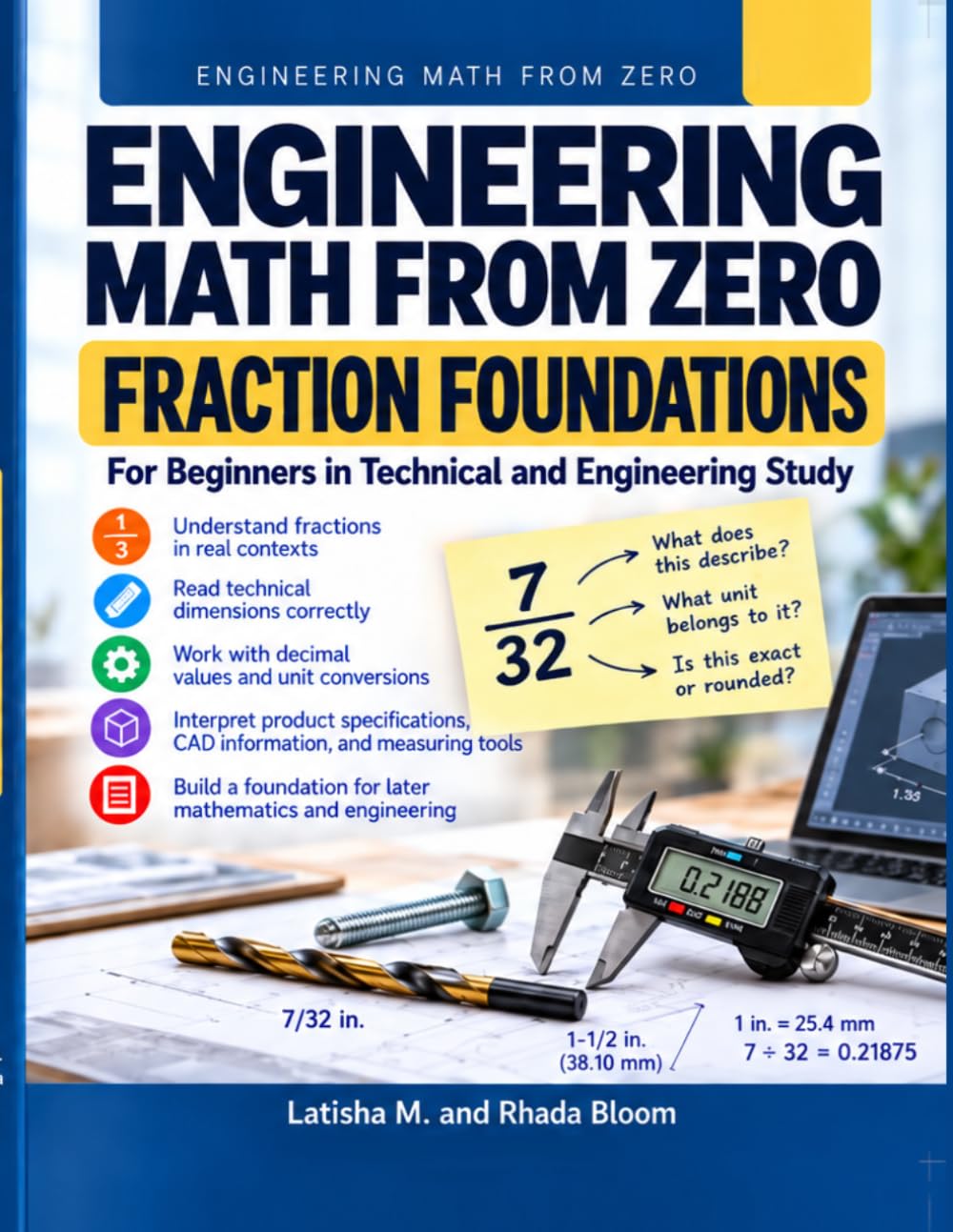
This book is especially suitable for:
Beginners who are not yet confident with fractions, mixed numbers, or decimals
Adults returning to basic mathematics after a long break
Vocational and technical students working with dimensions and numerical information
Students preparing for later study in mathematics, physics, or engineering
Learners who understand basic arithmetic but become uncertain when fractions appear in formulas or technical information
Beginners learning to read product specifications, technical dimensions, CAD information, or measuring-tool data
Self-learners who want to rebuild their mathematical foundation carefully
No prior engineering knowledge is required.
Engineering examples are introduced only far enough to help you read the mathematical structure and understand why the fraction matters.
What this volume does not try to cover
This is not a full engineering-analysis course or a comprehensive treatment of every fraction operation.
Topics such as:
Fraction addition and subtraction
Fraction multiplication and division
Systematic study of units and dimensions
Step-by-step equation rearrangement
are reserved for later parts of the series.
—————————–
This volume focuses first on a more fundamental skill:
See the fraction → read it correctly → identify what is being divided by what → understand what that division means in context.
If that is the foundation you want to strengthen before moving into more advanced mathematics, physics, or engineering study, Fraction Foundations is designed for that purpose.
Before you calculate, understand what the number is telling you.
————————
What this book does differently
This book connects basic fraction understanding with technical reading.
Fraction Foundations begins with the meaning and structure of fractions, then gradually connects those ideas to selected technical examples involving:
Fractional and mixed-number dimensions
Fraction-to-decimal conversion
Exact and rounded decimal values
Inch and millimeter dimensions
Product specifications
CAD dimension displays
Measuring-tool specifications
Simple engineering-formula structures
The book also uses selected real technical and scientific information—including manufacturer product data, NASA/JPL information, CAD documentation, and measuring-instrument specifications—to give the mathematics a practical context.
—————-
What you will practice
By working through this volume, you will practice how to:
Read fractions, improper fractions, and mixed numbers
Convert common fractions and mixed numbers to decimal form
Distinguish exact decimal values from rounded display values
Read common fractional-inch dimensions
Use inch–millimeter conversion as a cross-check
Distinguish specified dimensions, measured values, instrument resolution, instrument accuracy, and part tolerance at a foundational level
Read the basic mathematical structure of expressions such as ΔL/L₀, F/A, and (1/2)mv²
Recognize when the available information is not yet enough to support a technical conclusion
—————
rhadabloom.com
latisham.com
RELEASE CONTEXT
Release activity around this project
Project Details
View This Project
Available links for this project.